

BLENDING GROUND:
THE ART INSIDE
A SINGLE-VINEYARD WINE
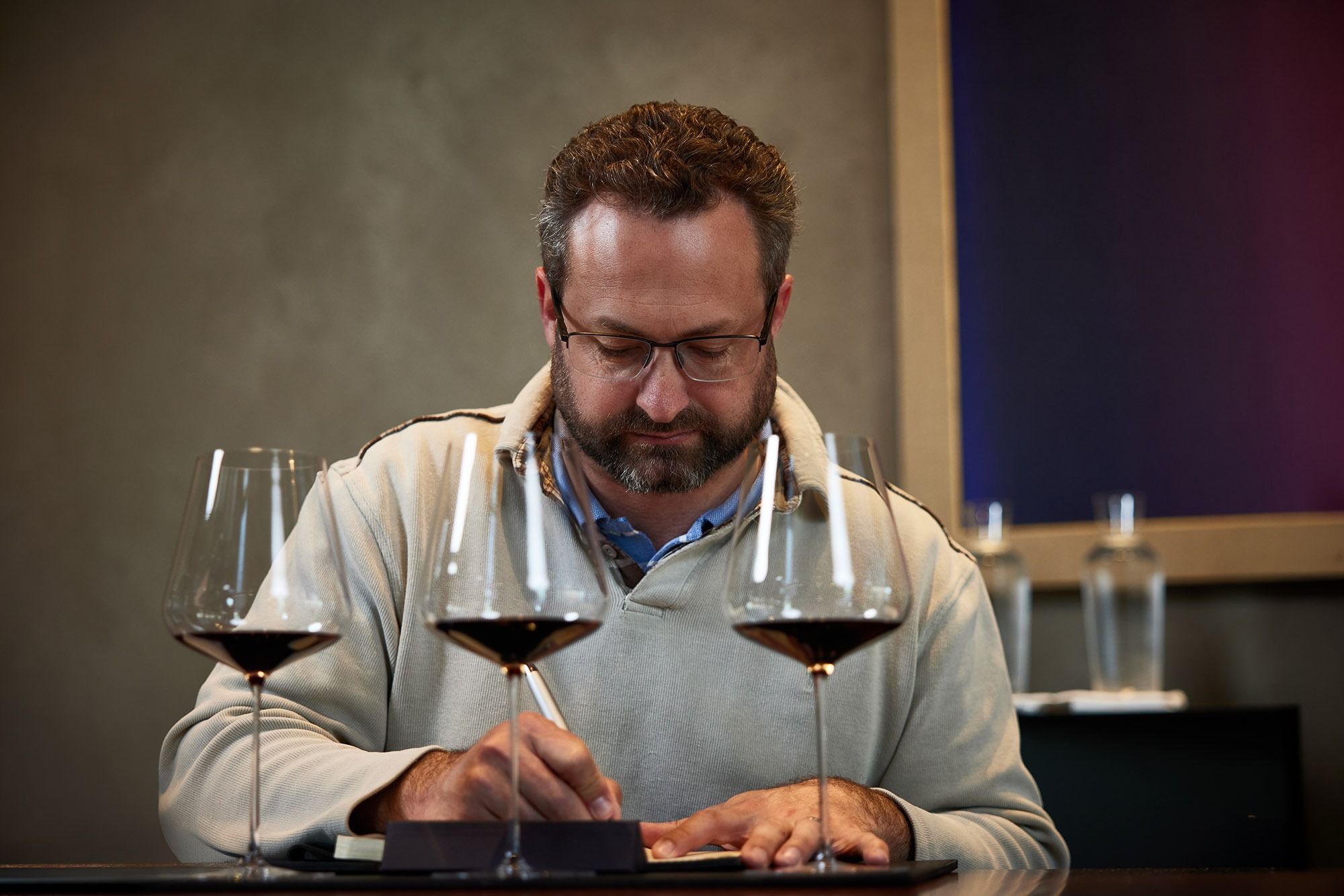
Every Seven Apart wine experiences the same birth, in a row of glasses on a table. Each holds a single lot from Stags Ridge, often just three or four barrels' worth, kept apart for more than a year. Somewhere in that row are Seven Apart’s Shale, Basalt, and Summit. The winemaker's work is to find them.
Find is the right word. "You can't make a wine be something that it's not," says winemaker Morgan Maurèze. Blending, as he practices it, is less a matter of building a wine than of recognizing one: learning what each lot can bring, then guiding it, a little, toward everything it could become.
It surprises people that these wines are blended at all. Each is 100 percent Cabernet Sauvignon from a single vineyard. But a vineyard is rarely one thing, and Stags Ridge is two.
ONE VINEYARD, TWO GROUNDS
Every Cabernet vine on the ridge is genetically the same, grown on the same roots and planted in the same year, 1999. Almost nothing varies except the rock. "I joke that the property is a grand experiment," Maurèze says.
To the north, the vines grow in volcanic basalt, a soil proprietor Don Dady once compared to a cobblestone street. To the south, only meters away, they grow in softer shale. Open a Shale and a Basalt side by side and you can taste the difference. Basalt, Maurèze says, is always the bigger, richer, more intense wine, and Shale the softer, silkier one.
"Ultimately," he says, "that's what we're blending: soil types."
Terroir is usually offered as a compliment. On Stags Ridge, it is closer to evidence.
A YEAR OF PATIENCE
The lots stay separate for at least twelve months, through fermentation and into French oak. Only then does blending begin, and it begins on paper. The team drafts a blend, sets it aside, and returns to it four or five months later. Nothing comes together until the team has tried it at the bench, drawn a sample from every barrel in each lot, and agrees with it.
Precision has limits. When a parcel's four barrels need splitting between two wines, the instinct is to taste each one and hand-pick two for each wine. Sometimes that works beautifully. Sometimes the better answer is the plain one: combine all four and take half for each.
"You have to learn to stop," Maurèze says. "Don't overthink it."
Part of a winemaker's taste is knowing what belongs in a blend. The rest is knowing when it is finished.THE BARREL THAT SEEMS WRONG
Blending's most humbling lesson runs against intuition. Combine the strongest lots and the result can fall short of what each promised alone. Then something that seemed wrong goes in, and the whole comes alive.
Maurèze first saw it about fifteen years ago, watching Michel Rolland, the Bordeaux consultant, build a final blend. Rolland added a wine Maurèze thought had no business being there. "I thought, what is he doing? This wine is terrible," he remembers. "And it made the final wine so much better."
His clearest example is press wine, squeezed from the skins after fermentation and firmer in tannin than the rest. It should make the blend harder. In Maurèze's experience, some of it sometimes makes the blend softer and more balanced.
"Sometimes you can be almost too purist to a fault," he says. "You add it in, and somehow it adds harmony. You can't explain why or how. It just does."THE SAME THREAD, A DIFFERENT YEAR
When it was announced that Maurèze would succeed Erickson, some members had wondered whether the Shale and Basalt they love were about to change. The vines had not changed, and the wines came into his hands with their styles already set. Blending is how those styles hold from one year to the next.
Continuity is not sameness, though. Maurèze wants each wine to keep its thread while carrying what he calls "a kiss of the vintage." "If it's the exact same wine every year," he asks, "what's the point?"BETWEEN THE TWO
Summit is where these ideas meet. Maurèze calls it "the perfect hybrid of the two": the richness and intensity of Basalt with the softness and silk of Shale. Shale and Basalt each ask how far one characteristic can go. Summit asks for both at once, in balance, and still carries the kiss of its vintage.
It is also usually the smallest of the three. A blend can draw only on what the vineyard gives, and "we're not looking to bulk up," Maurèze says. In 2022, Summit came to 196 cases. In 2019, and again in 2021, it amounted to only four barrels.AN ACT OF INTERPRETATION
Asked for the one thing he would want every member to understand about blending, Maurèze keeps it simple. "Let the wine speak for itself. We're there just to guide it a little."
That is why blending, for all its methods, is an art that is defined as an act of interpretation. A winemaker cannot make a wine into something its ground is not. What a winemaker can do, in Shale, in Basalt, and most visibly in Summit, is find everything that ground could be, and share that with the world.